# December Adventure 2024
- published on ,
- last updated
Hi! I’m participating in December Adventure this year! In contrast to a competitive advent calendar like Advent of Code, it is a low-stakes programming and journaling calendar taking place throughout december. I’ve participated in AoC for the past few years, for example solving 2023′s puzzle set using a different programming language each day. But I feel like now is the ideal time for me to take it easier and not to fuss about completion times or implementating algorithms. I welcome the change of pace.
# December 0
Today, I set up this page! I will be updating this page every day as my adventure log. I have some plans for the projects I’ll be working on — in particular I have ideas and a half-baked playground open on a different VSCode window. More on that tomorrow :)
# December 1
By the way, these updates will be in chronological order. Even though it’s worse for catching updates it seems easier to read through as a whole.
I’ve had this idea floating in my head for a little bit now: the Library of Babel in its modern form is still ultimately a digital recreation of a physical library. It maintains in spirit the feel of interacting with a library, through browsing and random stumbling, though it does add a string search as a form of “oracle” emphasizing the inscrutability of the library. How could the philosophical concept of the Library be reimagined in the era of the internet?
One particular thought that has bubbled in my mind is that of 88x31 badges. Seemingly popularized in geocities, they are a form of building interconnected social networks across websites. The badges act as a symbol of these digital relationships and the graph that they encode, which I think represents one goal of the internet (even if idealistic).
Fascinatingly, people have attempted to scrape and curate collections of these 88x31 badges forever, through a graph visualizations or plain old long lists. I say attempted because such a task is inherently impossible (that is, unless the internet were to become controlled by a couple of monopolistic platforms… yes this site is sadly hosted through GitHub). The internet is just too large and too dynamic to store as a list.
But what if you could? What if you did have an ultimate repository of all our relationships on the internet? This is indeed where I find the metaphor of the Library has the most potential. And that is what I have been working on for the past couple of weeks, including today. I have a skeleton webpage set up to display 1000 different random 88x31s generated on a server. I’m toying around with minimal features currently: old-web aesthetic without old-web inaccessibility, relatively sane dynamic scrolling of appallingly long lists, the specifics of the randomization algorithm. I have lots of things to work on this month and I am feeling motivated! Even though today I only tweaked some CSS (hehe, repeating JPEG backgrounds) I won’t say that I accomplished little (that would be false).
# December 2
Who says the updates have to be paragraphs long? Today, I just read about the JavaScript events and methods I could use for dynamically loading a list of images while maintaining an accurate scrollbar. Fun fact! The otherwise-reasonable strategy of “compute a fixed full height for the body and populate the page as it becomes visible” is not feasible due to the simple fact that the maximum value you can plug into a height CSS property is on the order of pixels on my Firefox. (Coincidence? That’s very close to the safe integer limit on 32-bit floats. Not going to dig out the specification for this one.) It’s so astronomically far off from fitting the space for images it’s not even worth calculating. I’ll likely have to resort to a simulacrum using a reasonably-tall document (so that regular scrolling won’t move the bar) and gamedev-esque viewing-frustum culling.
I would ideally like to have the whole page on a single infinite scroll, like all the information in this page is just at your (literal) fingertips. If only you could scroll forever and never get fatigued, you could learn all there is to know in this world…
# December 3
Slight change of pace! I worked on my portfolio today. Currently, the page is certifiably empty. I would like the page to contain a reverse chronological list of my highlighted work. Each entry has a visual element if possible, a title, date (to the nearest month), description, and outgoing links. While individual projects distinguish themselves from the others, the overall experience should be a smooth dive back in time.
So, to start I’ve been formulating lists of what to put there. I have a lot of projects stretching back a few years, with various themes and foci. I wonder what would be the best way to unify all of them? On one hand it feels crass to assign an “artness” metric to a project, on the other it feels odd to put conceptual work next to practical work. Maybe a different form of categorizing?
In terms of implementation, I think I will be using Jekyll’s include system to have a folder of portfolio entries that are compiled into a static page. That way I can store both structured (front matter YAML) and unstructured (HTML content) information. Though… I could also use data files to make every entry structured – if my goal is indeed to have an image, description, and other fields. That sounds quite reasonable, actually.
I also added some missing links around my site, such as a “home” link in breathing-geometry. That was a fun use of CSS grid.
# December 4
Hmm, using a real scroll whell as a replacement for a fake scroll wheel seems like an awfully fragile solution. And I don’t think it’ll be particularly portable. Perhaps it’s best to not try my luck overengineering a small feature and instead focus on the necessary elements of the experience.
# December 5
Today, as I was exploring dynamically generated 88x31 images, I realized that the page should load with the first page of content pregenerated. That sent me down a bit of a rabbithole with JS bundlers and static site generators. In the end I chose to use Hugo for some of the basic templating. I engulfed myself in the documentation until I figured out how to a) compile typescript, b) create elements in a loop, and c) pass configuration to typescript in a way that my editor didn’t complain (the solution was to add a .d.ts file and define a custom "paths": ... configuration in my .tsconfig!) But in the end I have a clean setup with templating, local hosting, and static generation! I can proceed to work more on the actual site code without getting side-tracked.
# December 6
So, to make my task a little bit easier to work on, I’ve published the image backend to the site on GitHub and deployed it to Vercel. Yes, unfortunately this project is hosted on two different online platform corporations. In an ideal world I would be running my own server to host. This site is static, running right now on GitHub pages (but SSGs can easily be interchangeable so long as you generate your static assets ahead of time). However, in order to have permalinks to Babel’s seeded-random images, I need some server-side computation. As far as I can tell, using Vercel for free Next.js hosting is a functional solution in the short term. Even if in the free tier is shut down in the future, and I have no doubt it will, there will be enough time to navigate over to my own server by then. I have attempted to minimize the amount of reliance on platform-specific features on my site, such as GitHub’s CI workflows, for similar reasons.
That is to say, the Vercel free tier’s bandwidth limits have already become a problem for my project. If each image displayed on the page is to be fetched from Vercel, and a single image equates to about 12KB of outbound traffic, then it takes 8 million images — aka about 9 hours of scrolling the infinite-scroll website — to deny service to the page for a whole month. Not good. I already managed to use up 50MB of traffic out of 100GB in my few minutes of testing. To alleviate this, I have switched to using <canvas> elements initialized with JavaScript instead. The page actually loads a lot faster now that it’s not waiting on a series of network requests.
The internet is increasingly controlled by a handful of digital giants. It is difficult not to partake in their platforms. I know many of us have a vision for a more open and indie web, building organic networks through interlinked personal sites and encouraging the use of open protocols. So, especially now in times of increasing political tension and threat of monopolistic deregulation in the tech sector, it is crucial for us to have backup plans. Do not rely on the whims of a single platform. Keep backups of your data. Keep alternate means of contact with your friends. Enshittification will come for us all. My own plan is to get personal web hosting running on a VPS, to distribute my Git repositories through alternate means such as the radicle protocol, and to ensure I have access to a backup of my cloud storage even if one service goes down. And perhaps my project could inspire others to contemplate the state of the internet today, and reach their own conclusions on the matter. Thank you.
# December 7
I haven’t done much today aside from small code tweaks, but I did spot every-uuid. What a funny coincidence that we created such a similar project! More specifically, the projects are similar in their technical details, but quite different in terms of their audience, direction, and (eventual) presentation. I appreciate the contrast. (In fact, there’s a lot of good tips in the technical implementation side!) I wouldn’t say our projects are ideologically opposed, but the direction that Every UUID goes in is much closer to “viral internet spectacle”. I have made projects like that before too, but it’s not quite my thing anymore. I’m glad that there is a steady supply of imaginative code out there to make digital life interesting :) I was pleasantly surprised to see the rest of the author’s portfolio, and I will follow them for more!
# December 8
I have implemented a simple reversible LCG to handle my seeded randomization. I have taken inspiration from the algorithm to the Library of Babel as well as the blogpost to every-uuid, hence LCG. This was pretty straightforward and I was confident in my ability (it helps that I am not trying to solve the task using an LLM). The goal here was to implement a permutation of numbers (with period ). Because LCGs are commonly used iteratively for PRNG purposes, it might be easy to implement that permutations as . But that would be a folly; since LCG with properly chosen parameters is already the permutation that we’re looking for! So is all it takes. The author of every-uuid missed this trick and used a different algorithm in the end, whereas the Library of Babel intentionally adds extra bitwise tricks to make the output look more random. It turns out that for image content a simple LCG suffices and looks random enough! Even the repetitiveness of lower-order bits is less significant when you realize that even a single pixel is 24 bits and hence repeats with a period of . When combined with the layout of the 88x31s this will be practically invisible. I did notice a small issue with my implementation, which was performance; it takes 150ms to parse the bigint literals from my code (that I selected randomly) and rendering to 256 canvases is pretty slow at 2 seconds total. I can always optimize this, but it’s a good starting point to compare to.
Wow I’m exhausted today… I should take a bit easier tomorrow. I sometimes get sucked into working on a project for far too long, and I forget to do other things in the meantime (such as drink my tea which is currently becoming cold). It’s a difficult balance to strike, enjoying myself while working on a thing and also taking care of myself. I don’t always balance myself very well. I think the fact that this log is public is also pushing me towards working more, which is counterintuitive… (The point of the adventure log is to journal, not to show off!) In any case I do want to learn from this December Adventure, so good night
# December 9
Fixed some broken CSS in yesterday’s log :) I also decided to look into the performance issues with my code. The first thing I did was to replace two of the bigint literals (the parameters to the LCG) with computed literals satisfying the necessary properties and that made sufficiently random images. This brought the parsing time down from 150ms to an acceptable 50ms, but that wasn’t necessarily the biggest priority here… I was actually able to speed up the rest of the code by a factor of 10 by replacing BigInt operations with string operations:
+ // I'm using a hex string as a u8 buffer
+ let hex = bits.toString(16);
---
- const rgb = Number(BigInt.asUintN(24, bits));
- bits >>= 24n;
- data.data[i * 4] = rgb >> 16;
- data.data[i * 4 + 1] = (rgb >> 8) & 0xff;
- data.data[i * 4 + 2] = rgb & 0xff;
+ data.data[i * 4] = parseInt(hex.substring(i * 6, i * 6 + 2), 16);
+ data.data[i * 4 + 1] = parseInt(hex.substring(i * 6 + 2, i * 6 + 4), 16);
+ data.data[i * 4 + 2] = parseInt(hex.substring(i * 6 + 4, i * 6 + 6), 16);
It’s cursed but the numbers don’t lie. I was honestly surprised at how well it worked, which probably goes to show how weak JavaScript’s bigints are. (Or it shows me that browsers can’t always optimize your code away, and that creating tons of GC pressure in a loop is a bad idea, or that sometimes the simplest solution is the best. Pick your favorite really)
# December 10
Today, I implemented dynamic loading based on scroll position, as well as some extra methods to jump to a page. I have a few functions that aren’t hooked up to anything yet; I’d like to get a persistent footer for navigation + reverse image search + scroll to top implemented tomorrow. Plus a fake scrollbar would be nice. Pretty simple mindless code for now.
# December 11
I implemented a sticky footer and the functionality I mentioned yesterday. There’s still stuff to finish, it’s not looking particularly pretty and the scroll position doesn’t have fidelity. I am happy chugging along with this :) I’m also pondering on the philosophical implications of this project, as well as the message that it’ll communicate. Who is my intended audience? Certainly not the general online programming population.
# December 12
A whole lot of chunky progress! Styling, structuring… and TONS of performance improvements. Primarily minimizing the number of bigint operations that I have to do. One thing that makes a huge difference is avoiding converting bigints to decimal strings, especially when scrolling at very large positions. Hexadecimal serialization is fine, because it only takes a linear scan through the bigint’s internal 64-bit (?) digits. However, printing in base 10 requires repeatedly dividing the bigint by a power of 10, which can be costly. Firefox performance devtools have been very helpful for me!
# December 13
Happy halloween!
It’s been a busy few days so I’ve ended up doing all my code late at night. I have still been compelled to write my entry daily. Today has been a lot of progress. In terms of performance there’s no noticeable jank anymore. I’m also making leaps in functionality, switching from rendering in units of pages to rows. Plus my silly hack that loops .getBoundingClientRect() inside the IntersectionObserver callback is pretty cute. (I am using it to fill the page until a loading indicator is no longer visible on screen.) Just need to update the row width dynamically in JS, plus implement upwards scrolling now. Ruminating on the essay, ought to get writing that too soon. I’m pretty happy with how the page is shaped. I wonder what kind of repeating gif would fit best in the background… Picking colors and fonts will be a joy.
# December 14
No code today. I’m exhausted.
# December 15
I got smooth row-based scrolling working pretty well! It took a bit of trickery but my current solution keeps up with a decent pace of scrolling and dynamically keeps the page filling up regardless of scroll. The only thing is that I need to implement the same thing scrolling upwards too, rather than just downwards.
I also finished the search-by-image functionality! My girlfriend served as my rubber duck for a lot of this, because it turned out I had a lot of bugs in my LCG algorithm (or rather my choice of parameters — some of them were negative and the precomputed modular inverse was just straight up wrong). As I explained process for efficiently converting a Uint8ClampedArray to a BigInt I realized that it was faulty (I forgot to pad my hex strings to length 2).
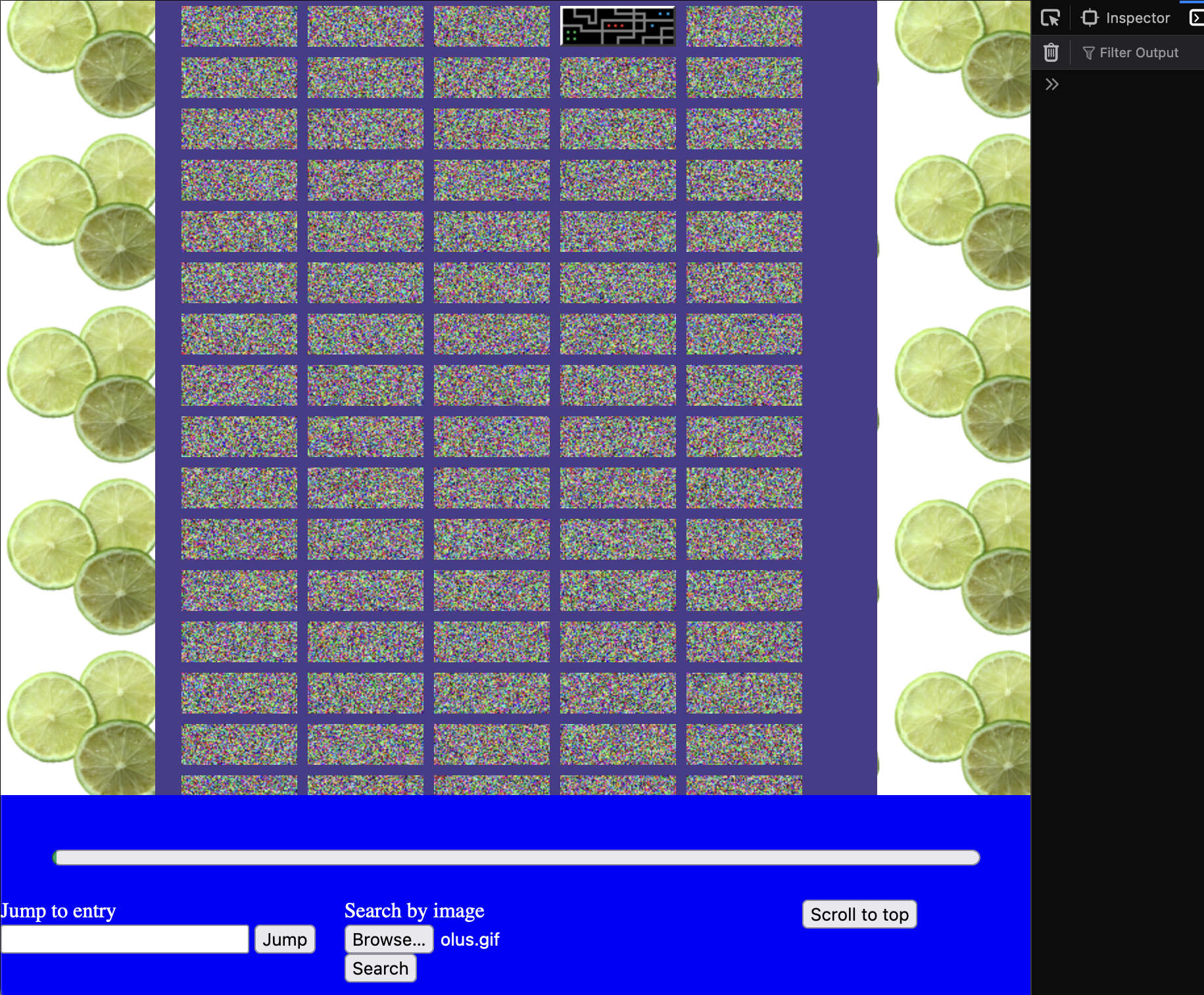
To celebrate this milestone, I’m showing one (1) screenshot :) Don’t mind the placeholder assets and styling.
# December 16
The finitude of the Library of Babel is subtle in its original formulation. By virtue of being inside the library, forced to take on the perspective of an ant, your perception of the library grows. A single human lifespan is quite strictly bounded, and the library is placed within the physical realm. Thus, the library creates a tangible representation of unreachableness. For all practical purposes it is infinite.
But the library is, at least as described, only able to contain a finite number of unique books. The precise size of the alphabet varies between 20 and 30 per interpretation and adaptation, but stays finite. A page must in turn also contain only finitely many characters (around 3000 is sensible). Finally, a book can only have finitely many pages (400?). Putting all this together, we find that there are unique permutations of letters (i.e. books) — a far cry from infinity!
(As a side note, the web version of the library only contains every unique page of 3200 characters rather than every n-page book of such pages. I assume this is for technical reasons, but this does mean that it only contains unique pages of text… which is less than the number of banners on my page. In fact, a banner can store the same amount of information as about 4 pages of text! An image indeed says more than a thousand words.)
The tension between the finite and infinite comes from how we are able to interface with the library. As a lone wanderer inside a megastructure, one’s only option is to traverse the hallways. The books one is able to read, or even to reach, are but a drop in an ocean compared to the vastness of the whole library, finite or not. One’s search for hidden knowledge is doomed from the start, for the likelihood of finding any coherent text is infinitesimal — much less text that communicates information beside entropy.
In the online version of the library, we are given additional means of interacting with the library. We can locate a book by its position in the library, eschewing the need for physical traversal. We can also jump directly to a random position in the library, as if whisked away by reality. Finally, we are able to search for the precise location of specific sequences of characters, effectively allowing us to recall books we know to exist in the library.
Notably, these extra methods do not allow us to gain any more knowledge from the digital library that the physical library didn’t offer. While we are able to find more instances of coherent text (simply by searching for it), we are not able to find any information that was not provided by us in the first place. Jumping to a random or specific coordinates is no good, either — since there’s no pattern to the contents of a book at a coordinate, every turned page is equally likely to contain a prayer. Thus, the theoretical inaccessibility of the library is maintained.
However, these additional capabilities introduce tension between the apparent infinitude and the theoretical finitude of the library. We are no longer acting from within the library, but rather outside it. The physical metaphor of the library begins to break apart as soon as we are able to transcent physical barriers and jump to arbitrary points within. The library becomes a thing to be interacted with, rather than an environment to traverse. The medium of a webpage promotes the former kind of interaction. Nevertheless, it does not necessarily imply bounds on the library as a thing. We only see a snapshot of the library at any given point in time and thus are not privy to the size, outside of calculations like those above.
So what if this tension was then taken further? What if it was faster and simpler to traverse the library? What if the finitude of the library was displayed to you at every step? What if you were presented with an abstraction of the whole library in a single thing? I am interested in exploring how far this tension can go before something snaps. I hope that this can push those borders further, through the single continuous scrollable page, the speed at which you can zoom through images, the progress bar in the footer, and the general presentation of the site.
# December 17
I got sucked into writing a lot of code today! I first implemented upward scrolling, then responsively updating row widths, then pushed all the slow screen-freezing number crunching into a web worker. Well, it turns out, all the screen-freezing number crunching is unnecessary after all, since a feature of the PRNG used (LCG) is that successive elements are a constant distance apart modulo . So I turned a few seconds of freezing into a crisp ~200ms. Still enough of a freeze that it’s good to compute in a worker thread, but not nearly as catastrophic as before.
In fact, it’s so easy it makes me question whether I want to use an LCG here in the first place. Surely it is too predictable? Perhaps this is what the creator of every-uuid was thinking of when they wanted to use the LCG function recursively. However, for my design decisions this fits well: it makes the overall experience of scrolling faster and thus shrinks the perceived size of the library as a bounded thing.
The irony of this smallness, of course, is that it’s only an illusion. While there is a helpful progress bar telling you the percentage of the library that you’ve visited, if you start scrolling from the top of the page it will never tick past 0.000000%. Only by jumping ahead is it ever possible to traverse other locations on the page. But the promise of the number is tantalizing; I’ve scrolled so far, surely I am close to passing a measly millionth of a percent? (Hint: each millionth of a percent contains banners…)
# December 18
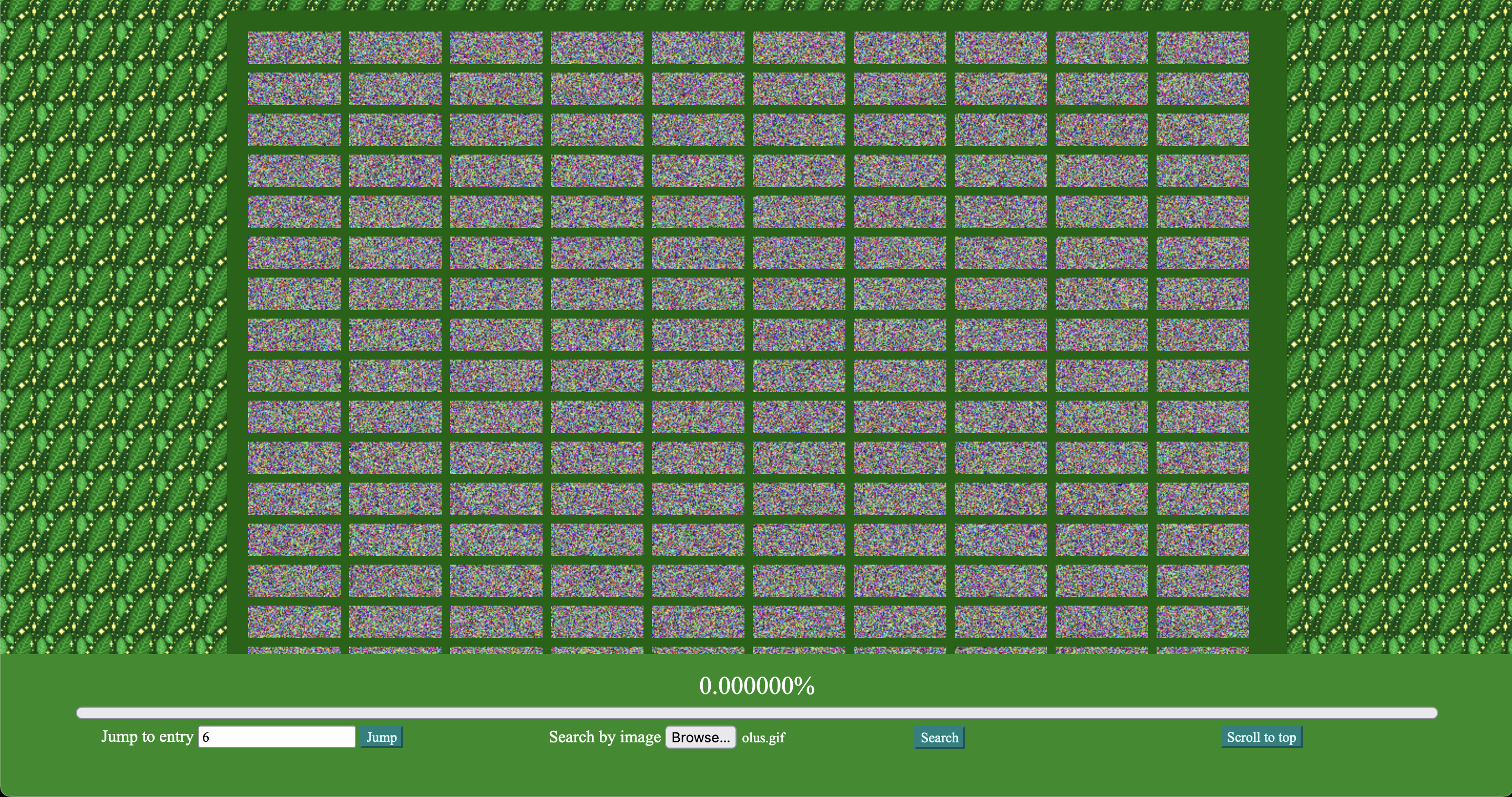
Pixel art and web colors today! This calls for a new screenshot!
# December 19
The overall experience is really coming together beautifully. The navbar at the bottom looks adorably antequated, the colors are smooth and gentle, and the favicon makes me feel strong emotions when I look at it.
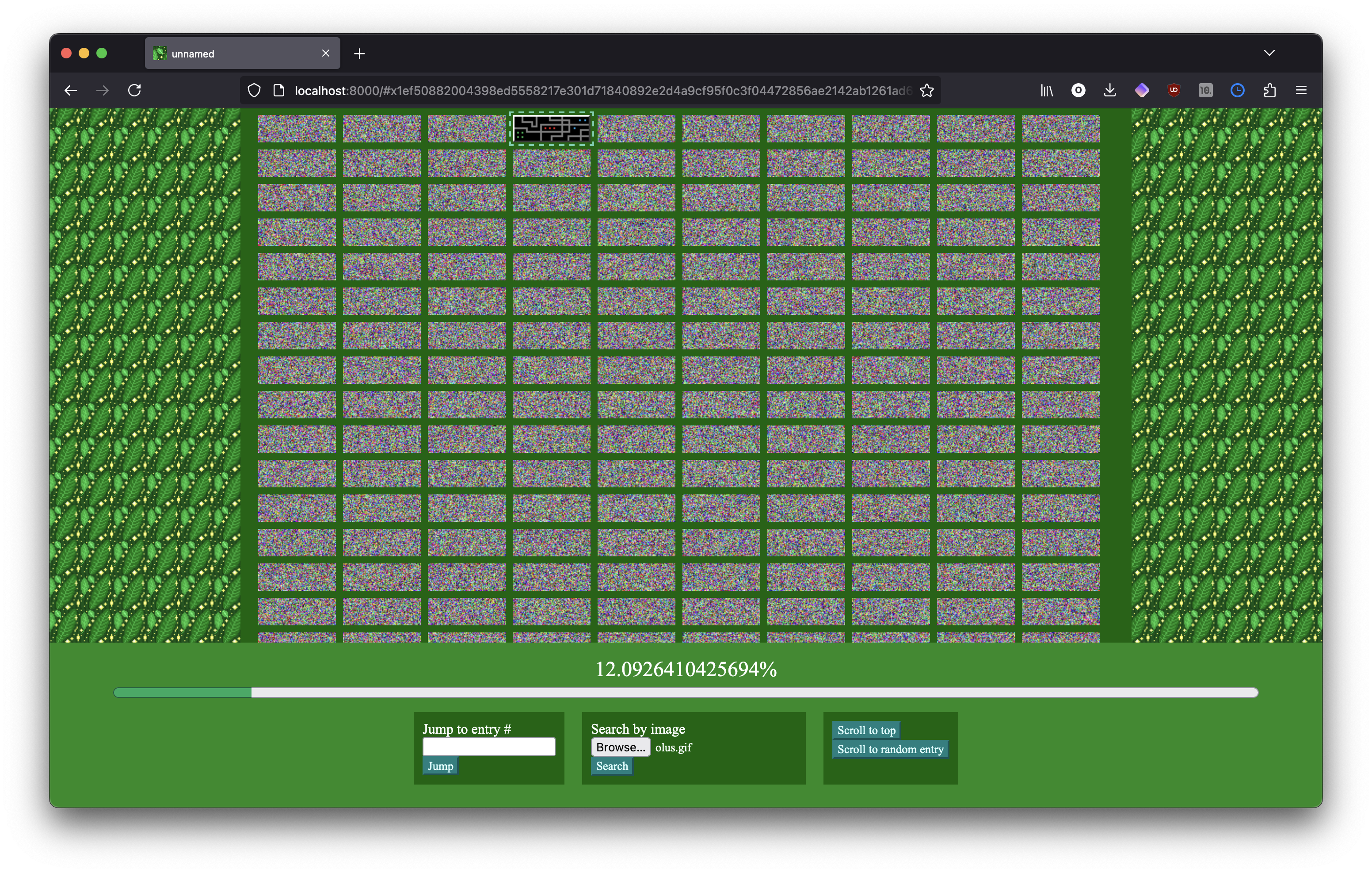
Something about the icon triggers an emotional response in me. It’s serene and natural, but full of detail and shine. Even though it’s just a 16x16 crop of the background image I drew up yesterday, it feels very powerful. Listening to this feeling I had a revelation about what this project was about — in thematic and aesthetic terms, it is like a forest or a starscape. Despite apparent chaos, it is in the order that is most natural within its own rules. It’s not beholden to the whims of humans, and we will never be able to fit every detail of a forest in our minds. We are always casting a flashlight — or radio telescope — on a very narrow slice of the world that exists, independent of our understanding of said world. Ironically, it is not a digital garden.
How can I reconcile this theme with the idea of putting bounds on the forest? It feels like the infinite forest is quite overpowering against attempts to confine and bound it. There’s almost a thematic dissonance in the progress bar. Perhaps the dissonance is part of the point? The navbar is distinctly separate from the rest of the forest. I could highlight that with a border, or perhaps a slight shift in colors. In that way, the page encompasses both the forest itself, and our attempts to wrangle with it.
It’s strange sometimes, how art seems to reveal itself to you rather than you creating it. Like the art was there all along and I was merely traversing towards it without realizing. It feels immensely satisfying to have these moments of revelation, though. Divine even.
Update: I went ahead and added the border. I decided to also add a button to take a walk in the forest, which hides the navbar from view and automatically scrolling the page down at a leisurely pace. That’s my attempt at reconciling the two different directions on the page — which in effect is my “solution” to the tension at the core of it. I guess I can’t help but to imprint my own interpretation on the work.
# December 20
Finally decided on a name: Babel’s Digital Forest (with plenty of sparkling unicode characters thrown in). With a name, I can now upload the wip to github. It’s live on project site, although it isn’t linked anywhere yet.
# December 21
Winding things down for the holiday days. I’ll be chipping away at my essay in the meantime.
# December 22
I added responsive scaling so the page looks clean on mobile devices, too. The header of the site is now looking in character. The essay is progressing, I have a document with notes jotted down in it.
# December 23-25
Merry christmas!
# December 26
It is done! I have finished the essay (well, enough to put it out there) and added final tweaks to the page. Babel’s Digital Forest is now ready!
# December 27
Chilling out, worked on my discord bot a bit. Halfway through implementing a +tempemoji command that adds and deletes emoji upon request, for a friend group to use.
# December 28
And done! Chilling out now :)
# December 29
Basking in the satisfaction of a job well done! And adding pronouns to emoji.
# December 30
Have you ever noticed how the last digit in power of 2 in base 10 repeats in a symmetric pattern? 2 -> 4 -> 8 -> 6 -> 2 -> ...
    8       8
     \       \
      6       6
                   ...
  4      4
 /      /
2      2
Well, I thought to investigate that symmetry, and in particular to see what sorts of Frieze patterns can show up when varying either the power or the base.
I wrote up some BQN code to test this, since it seems like the sort of problem that fits well in array thinking.
I initially found that many cycles are finitely offset, e.g. in base 4, powers of 2 have the following pattern: 2 -> 0 -> 0 -> ...
I computed the cycle for each value, and visualized it as a matrix like below:
0010000000 # i.e. 2
0000100000 # i.e. 4
0000000010 # i.e. 8
0000001000 # i.e. 6
I trimmed the matrices to ignore columns of zeros, then computed the four kinds of symmetries possible in each image:
- Reflections across the direction of travel (i.e. bilateral symmetry in the cycle)
- Reflections perpendicular to the direction of travel (like an infinity mirror)
- 180 degree rotations around some center point
- Glide reflections
It turns out that only five of the seven Frieze groups can show up in this scenario, which I’m sure can be proven with a bit of elementary number theory.
- pq1: No special symmetries, only translation. Example:
3 -> 2 -> 6 -> 4 -> 5 -> 1 -> 3(powers of 3 in base 7) - p2mm: All kinds of symmetry, but in a boring way. Example:
1 -> 1(powers of 1 in any base) - p2mg: All kinds of symmetry except bilateral symmetry. This one’s also slightly underwhelming, since all the examples just alternate between 2 value., Example:
2 -> 1 -> 2(powers of 2 in base 3) - p2: Translations and rotations. These end up pretty neat. Example:
4 -> 2 -> 1 -> 4(powers of 4 in base 9) - p11g: Translations and glide reflections. Pretty cute as well. Example:
2 -> 4 -> 8 -> 6(powers of 2 in base 10, duh)
I marked #1 with spaces, #2 with dots, #3 with M, #4 with R and #4 in G in the diagram below.
Here’s the final code to generate these insights, as well as the diagram.
Powers ← {(𝕨|𝕩×⊢)⍟(1+↕𝕨) 1}
Cycle ← {fr←⊑(∊𝕩)⊐0 ⋄ (fr⊏⊐𝕩)↓fr↑𝕩}
Visualize ← >{𝕨↑/⁼⋈𝕩}¨
Trim ← {1+⌈´𝕩}⊸Visualize ⊢-⌊´
Zoom ← {Double ← {((≠𝕩)⥊2)/𝕩} ⋄ Double˘Double 𝕩}
# inefficient but it works :)
Classify ← {
  horizon ← 𝕩≡⌽𝕩
  _offset ← {∨´(↕≠𝕩)(𝔽≡⊢)∘⌽¨<𝕩}
  mirror ← ⌽_offset 𝕩
  rotation ← (⌽˘⌽)_offset 𝕩
  glide ← {⌽˘((≠𝕩)÷2)⌽𝕩}_offset 𝕩
  ⟨horizon,mirror,rotation,glide⟩
}
Format ← {
  0‿0‿0‿0: ' ';
  1‿1‿1‿1: '.';
  0‿1‿1‿1: 'M';
  0‿0‿1‿0: 'R';
  0‿0‿0‿1: 'G'
}
Diagram ← {b𝕊n: Format Classify Zoom Trim Cycle b Powers n}

# b ≥ 2 obvs
(2+↕18) Diagram⌜ ↕30
Horizontal direction is the number being multiplied, vertical direction (downward) is the base this is computed in.
┌─
╵"..............................
  ..M..M..M..M..M..M..M..M..M..M
  ...M...M...M...M...M...M...M..
  ..GGM..GGM..GGM..GGM..GGM..GGM
  ..M..M..M..M..M..M..M..M..M..M
  .. G GM.. G GM.. G GM.. G GM..
  ...M.M.M...M.M.M...M.M.M...M.M
  ..G.RG.RM..G.RG.RM..G.RG.RM..G
  ..GGM..GGM..GGM..GGM..GGM..GGM
  ..G   GGG M..G   GGG M..G   GG
  ..MM.M.MM..M..MM.M.MM..M..MM.M
  ..G GGGGG GGM..G GGGGG GGM..G
  .. G GM.. G GM.. G GM.. G GM..
  .. GMM.  M.MG M.. GMM.  M.MG M
  ...R.R.M.M.R.R.M...R.R.M.M.R.R
  ..GGGGGGGGGGGGGGM..GGGGGGGGGGG
  ..G.RG.RM..G.RG.RM..G.RG.RM..G
  ..GG    G G GGGG  M..GG    G G"
                                 ┘
# December 31
And that’s December! Happy new year :)