# Breathing new life to Breathing Geometry
- published on
A few months ago, I created Breathing Geometry, a geometric breathing exercise centered around regular polyhedra. At the time, I considered it complete, albeit minimally. Now, I’ve returned to give a breath of new life into it.
If you wish to jump straight to the juice, click here to see the new page in action! I’ll be waiting back here. Otherwise, read on.
I initially created the page for a university course. As a consequence, I had a fairly strict timeline for the project. I do appreciate a more fixed time limit, and I find it helps me get a project standing on its legs faster. Faster than my typical ballooning scope monsters!
That being said, time limits do also necessitate some level of prioritization. Not all tasks or ideas can fit inside a period of time, and thus some must be left out. This was also the case with Breathing Geometry. While I was able to complete the project, I didn’t feel as if it was fully featured yet. For example, while one of the goals of the projects was to visually incorporate shapes’ spherical geometries, I was not able to get a satisfying implementation done in time; hence, it was left only implied.
Now that it’s been a little while, I thought to return and give the project its finishing touches. At this point it’s been long enough for me to feel confident in any lingering features. The foremost of these is, of course, the visual spherical geometry!
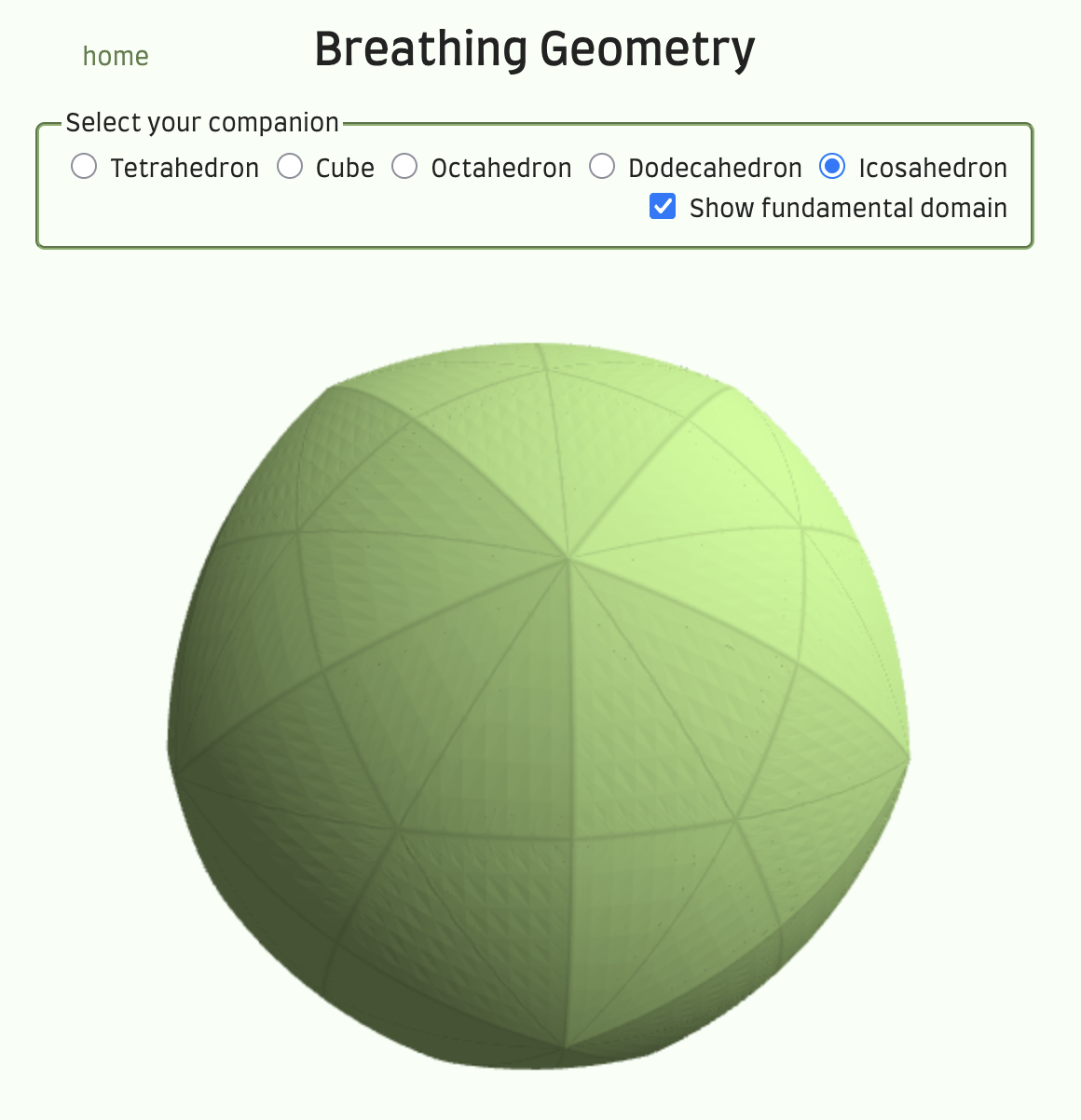
I wanted to visually convey the fundamental domain of each of the shapes’ symmetry groups. While the shapes smoothly oscillate between spheres and polyhedra, the fundamental domain (drawn as a set of lines on top of the shape) stays constant. This represents the fact that these oscillations do not impact the underlying symmetry of the shapes themselves. I found that quite fascinating!
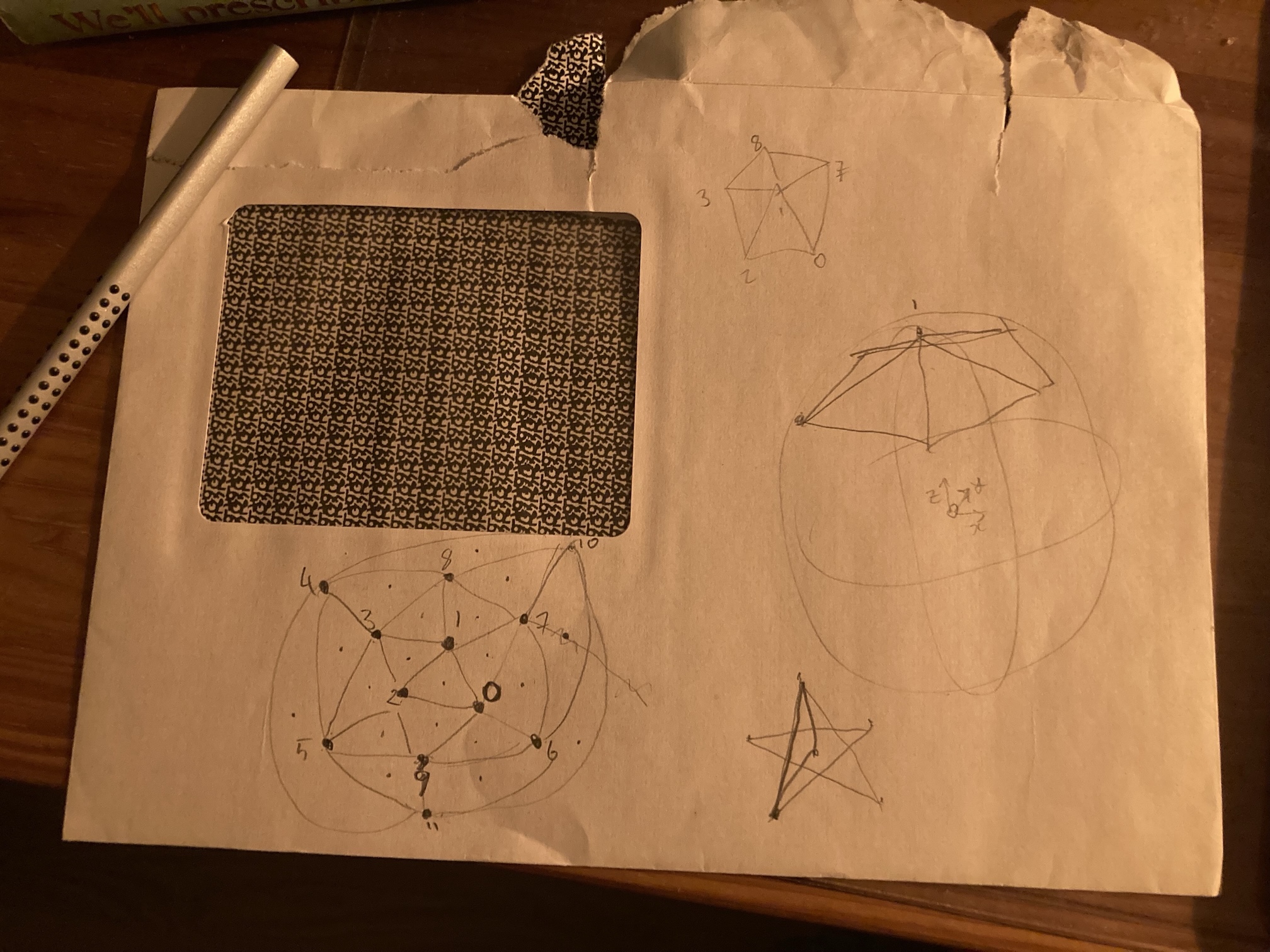
I chose to embed the fundamental domain within the meshes of each of the polyhedra. Given that all of the meshesare programmatically generated, I thought it would be appropriate for this addition to also be algorithmic. I then spent some time tinkering with the algorithm on the back of an envelope:
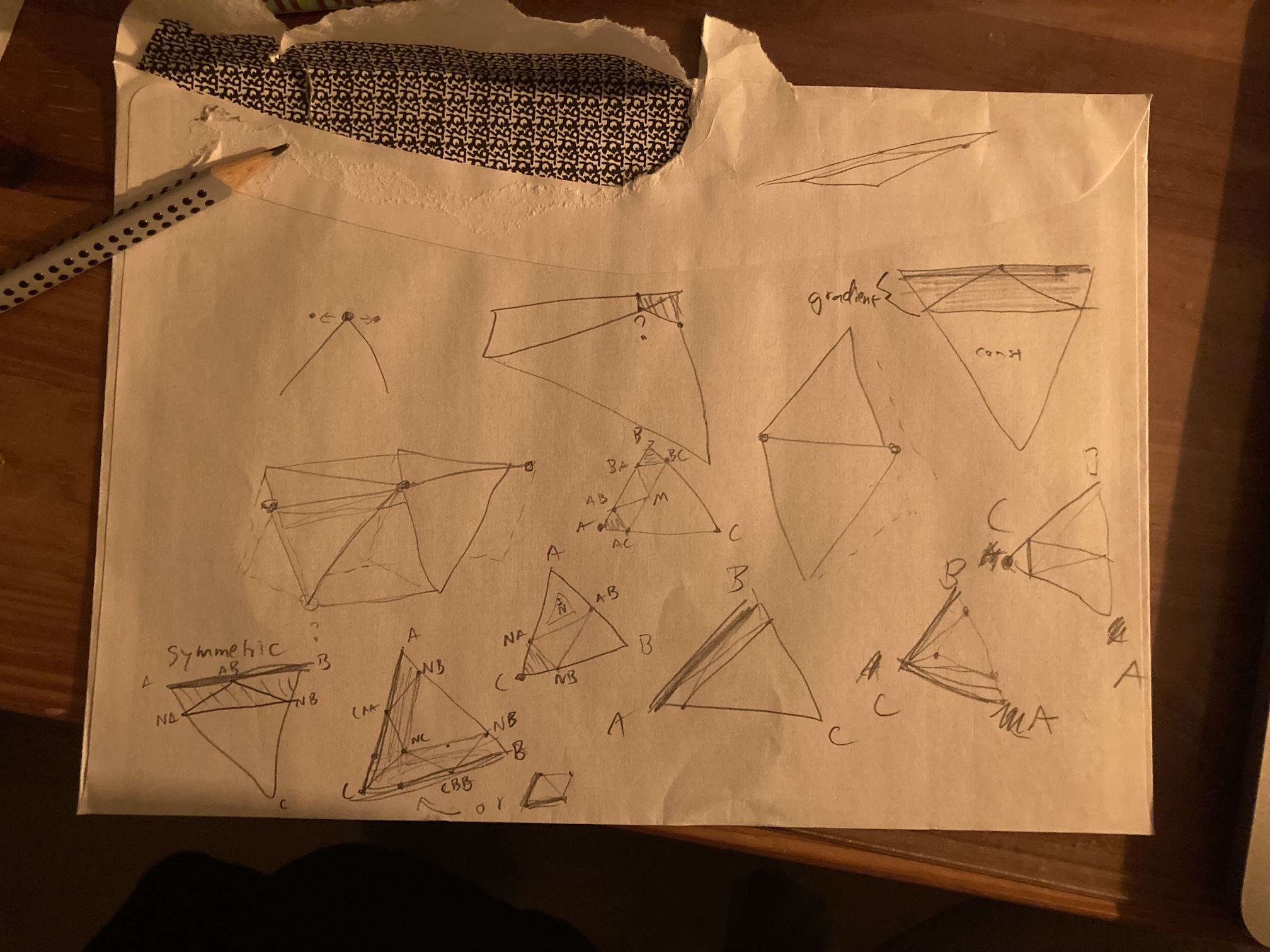
I find that code, especially something very algorithmic, is a lot easier for me to design on paper. It’s very visual, and it lets me sort out my thoughts spatially. That’s why I keep a little notebook with me!
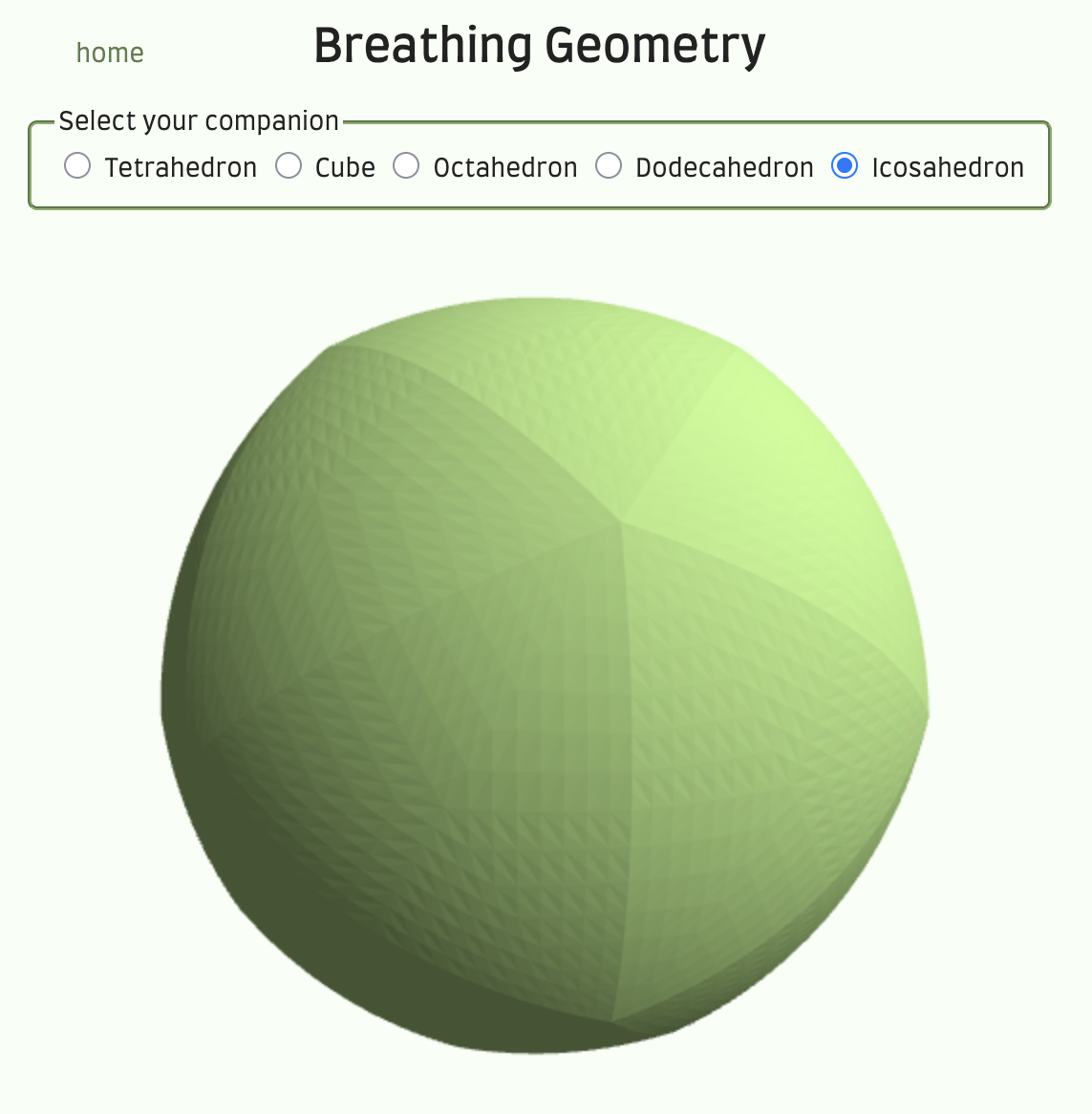
Now, the results looked fairly good. The lines are subtle but still clearly impact how you see the shape. The shapes look a bit more lively and multidimensional thanks to the additional shade of green. I later on added a small animation that slowly pulses the colors of the lines, imitating a sort of abstract heartbeat. Combined with the imagery of breathing polyhedra, a heartbeat was a natural addition.
You can see a rough comparison (not accounting for animation) below:
Now, I wanted to add one more feature before considering the project complete. A little bit of spice to extend the basic themes. I therefore chose to add one additional polyhedron to the list of companions. I deemed one to be enough, since otherwise the selector UI would become cramped and steal the focus away from the animation itself.
Strictly speaking, I have already included all of the basic regular polyhedra, i.e. the Platonic solids. Thus, any addition would have to be in a class of more “exotic” polyhedra. Some of these classes include the Kepler-Poinsot polyhedra, the Archimedean solids, and other kinds of uniform polyhedra. I chose my addition from the Kepler-Poinsot polyhedra, since they are closely connected to the Platonic solids and are also visually the most interesting in my opinion.
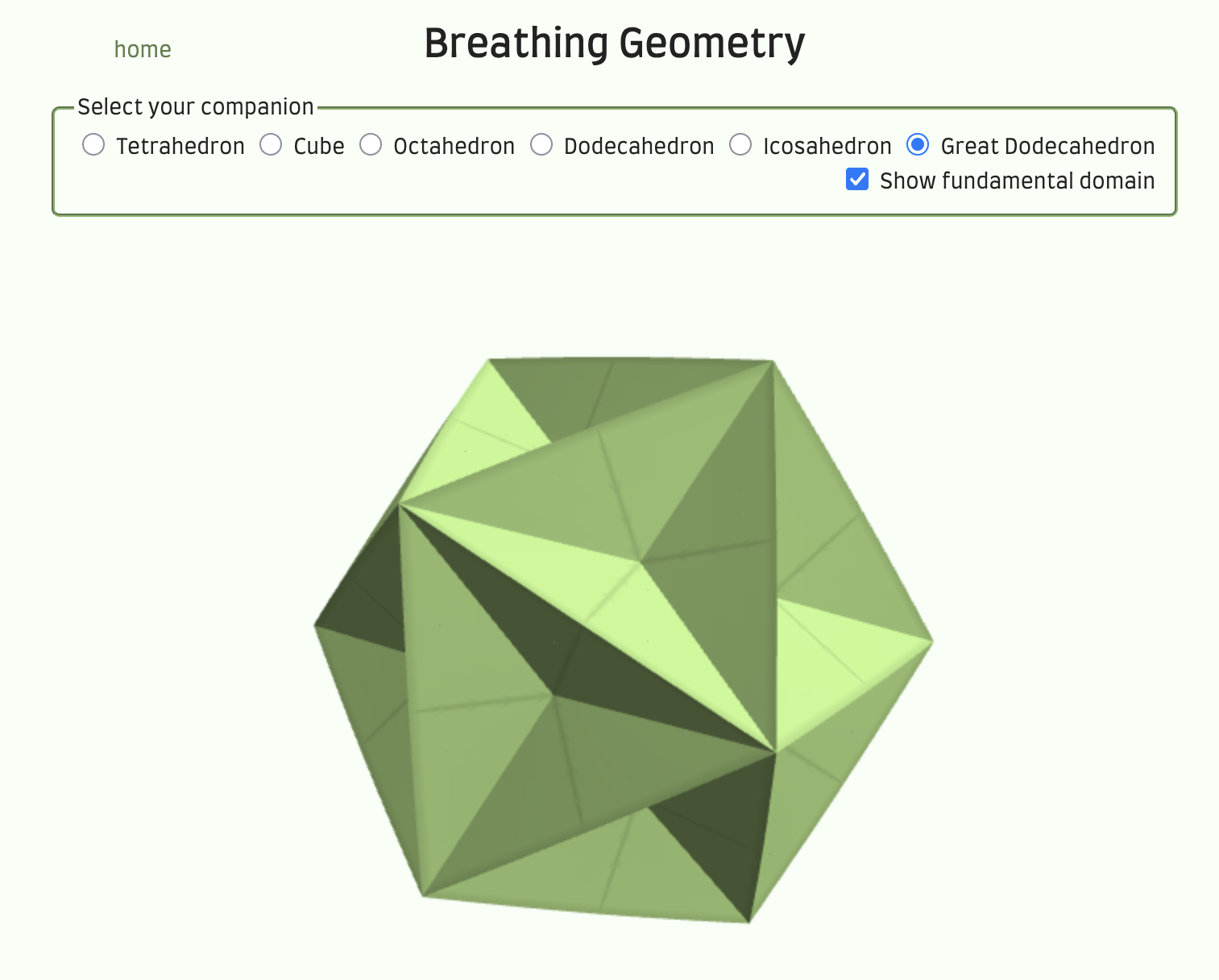
I had some difficulty choosing a fitting shape, but eventually settled on the great dodecahedron. I found it struck the right balance of finality and groundedness. Plus, the name “great dodecahedron” just fits so well as the last element of a list!
Since the great dodecahedron uses the same edges as an icosahedron, I was able to reuse some of my previous code in this new mesh. I did manually compute the edges in each face, though:
Finally I can say that the project is fully featured! I love how the little touches have made the whole thing feel a lot more complete. There is of course room to improve on the performance front (such as computing normals inside a shader), but I am very happy with the results overall.